


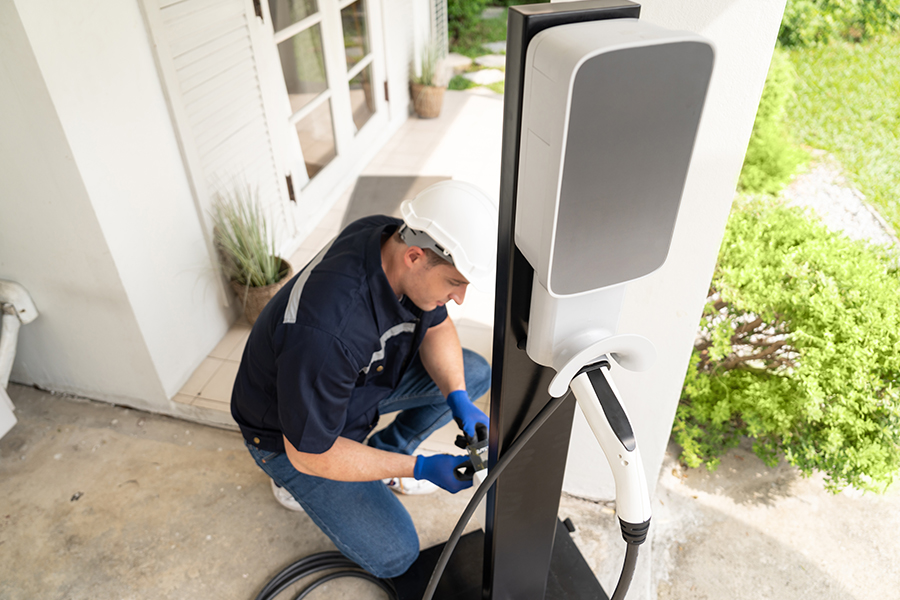
Electric vehicle charging equipment draws a heavy, continuous load for extended periods, often overnight. That demand is placed on the electrical panel, the branch wiring and the grounding and bonding system for hours at a time. Correctly designed and installed equipment charges reliably. Equipment installed on an undersized circuit, or on a service already close to capacity, can result in nuisance breaker tripping, overheated connections and charging performance below what the equipment is rated for.
Professional electric car charger installation addresses those conditions before the equipment is energized. A licensed electrician sizes the circuit for the load, completes a calculated load review to confirm the existing service can carry the additional demand, and files the notification of work required for the installation. At Canadian Wire Wizards, we are licensed EV charging station contractors working with homeowners, condominium boards, property managers and business owners across Toronto and the GTA. We complete the assessment, the notification, the installation and the final testing within a single scope of work.
Electric Car Charger Installation in Short: Electric vehicle charging equipment places a heavy, continuous load on a home or business’s electrical panel, branch wiring, and grounding and bonding system, often for hours at a time. A professional electric car charger installation includes a site and load assessment, a calculated load review confirming the existing service can support the equipment, notification of work to the Electrical Safety Authority where required, and a final inspection. Involving a licensed EV charging station contractor before the equipment is purchased helps confirm panel capacity and avoid costly changes once the vehicle arrives.
Before installation, property owners should confirm whether the existing service, commonly 100 amp or 200 amp, can support a Level 2 charger, whether the unit will be hardwired or installed on a receptacle, and how much capacity any panel upgrade may need to provide.
Working with a licensed electrician who completes the assessment, the ESA notification, the installation and the final testing within a single scope of work helps keep the project on schedule and code compliant.
What Electric Car Charger Installation Includes
A complete electric car charging station installation involves more than mounting the equipment and running a conductor to it. The additional steps are what keep the installation safe and serviceable over its service life.
A typical scope covers:
Site and load assessment. We review the panel, the available breaker positions, the existing loads and the location where the vehicle parks.
Calculated load review. This establishes whether the existing service can support the equipment as it stands, or whether upgrades are needed first.
Notification of work. Where the installation requires it, we file with the Electrical Safety Authority before work begins.
Dedicated circuit. A new breaker, conductors sized for the load, and conduit or cable routed through the building.
Mounting and connection. The unit is secured to a solid surface at a suitable height, positioned so the cable reaches the vehicle charge port without strain.
Grounding and bonding verification. These are tested rather than assumed.
Testing and commissioning. Voltage, polarity, ground continuity and breaker function are verified, followed by a live charging test using the vehicle or a test load.
Handover walkthrough. Operation of the unit, the meaning of the indicator lights, and the steps to follow if the equipment faults.
Inspection and documentation. An Electrical Safety Authority inspection and, on approval, a Certificate of Acceptance retained with the property records.
Undersized circuits are a recognized cause of nuisance tripping on charging installations. Equipment that operates without issue in mild weather can begin tripping the breaker in winter, when heating, laundry and vehicle charging draw at the same time.
Choosing the Right EV Charging Solution for a Property
Charger selection depends on the vehicle, the parking arrangement and the capacity of the existing electrical service. These vary considerably from one property to the next.
Level 1 (120V) operates from a standard household receptacle and adds roughly 5 to 8 kilometres of range per hour under typical conditions. Actual rates vary with the vehicle, the ambient temperature and the equipment. This can be adequate for short commutes, plug-in hybrids and vehicles that are driven infrequently. It requires a properly grounded dedicated receptacle rather than a full charging installation.
Level 2 (240V) is the common choice for residential and workplace charging. On a circuit in the 40 amp range, added range is often in the area of 30 to 50 kilometres per hour, depending on the vehicle, its onboard charger, the temperature and the equipment specifications. For many vehicles this supports a full charge overnight.
DC fast charging is used at commercial and public sites. It generally requires three phase power and a substantially larger service, which places it outside the scope of a typical residential installation.
Several decisions come up on most quotations:
Amperage. Continuous loads are generally supplied by a circuit rated above the equipment rating. A 48 amp unit is typically fed by a circuit in the 60 amp range, and a 40 amp unit by a circuit in the 50 amp range, subject to the applicable code requirements and the manufacturer specifications. A larger unit is not always suitable where panel capacity is limited.
Hardwired or receptacle connected. Hardwiring suits permanent installations. A NEMA 14-50 receptacle allows the unit to be removed or replaced.
Smart features. Network connectivity, scheduled charging for off peak periods, consumption tracking, and load sharing between two vehicles.
Cable length. The measurement is taken to the vehicle charge port rather than to the parking space, since port locations differ between models.
Outdoor rating. Driveway and carport installations require a suitably rated enclosure and mounting hardware appropriate for local weather conditions.
The vehicle, rather than the charging equipment, often sets the effective charging rate. Each electric vehicle has an onboard charger that limits the AC power it can accept. Published limits vary by model, with many current vehicles falling in the range of roughly 7 kW to 11 kW or higher. Where a vehicle accepts around 7 kW, supplying it from a 48 amp unit does not increase the rate at which it charges. We review the vehicle specifications during the assessment and size the installation to suit them.
Our comparison guide, Level 1 vs Level 2 EV Charging: What Works Best for Your Home?, reviews the speed and cost considerations in more detail.
Residential and Commercial EV Charger Installation Services in Toronto
The electrical fundamentals are consistent across both. What changes is scale, access and how consumption is billed.
Residential installations cover attached and detached garages, driveways, carports and side yard parking. Detached garages generally require a buried feeder and in some cases a small subpanel, which is a larger scope than mounting equipment close to the main panel. Semi-detached and row house properties in older Toronto neighbourhoods often have limited service entrance space and few available panel positions, which makes the assessment central to the design.
Commercial and multi-unit installations include:
- Workplace parking for staff and visitors
- Retail, restaurant and hotel customer charging
- Condominium and apartment parking garages, including individual suite installations
- Fleet depots with several units charging on a shared schedule
- Municipal and institutional properties
Commercial electrical work introduces additional considerations. These can include networked equipment with billing and access control, load management so that a group of units does not exceed the capacity of the service, submetering for cost recovery, trenching and bollards in exposed lots, and accessibility requirements for designated spaces. Condominium installations also involve the board, the declaration and the existing garage infrastructure before the electrical design is finalized.
In multi-unit residential buildings, one approach is to complete a building wide EV readiness plan before individual installations proceed. This involves a capacity assessment for the whole building, a shared load management system, and conduit and panel infrastructure sized for anticipated demand. Individual owners then connect to that infrastructure as they acquire vehicles. The approach reduces the risk that the earliest installations consume the available capacity before later requests are made.
For commercial properties, infrastructure is often designed with capacity beyond current requirements, so that further units can be added without repeating the underground and structural work.
How Licensed Electricians Assess Electrical Capacity Before Installation
The capacity assessment establishes whether the existing service can carry the additional load.
Residential services in the GTA are commonly rated at 100 or 200 amps, and some older properties that have not been upgraded are rated lower. Electric vehicle charging equipment is treated as a continuous load, meaning it draws at or near its rated current for extended periods without interruption. Continuous loads are sized differently from intermittent loads under the applicable code, which is why the supply circuit is rated above the rating of the equipment itself.
The assessment covers:
Service size and meter base rating. What is actually supplied from the street.
Panel capacity and available breaker positions. This includes the condition of the existing breakers.
A calculated load. Floor area, heating type, range, dryer, air conditioning and any additional large loads such as a hot tub or workshop are all counted.
Consumption history. Where available, metered demand data can support a more accurate calculation than a worst case estimate.
Panel and equipment condition. Signs of overheating, corrosion, double tapped breakers, or obsolete equipment for which listed replacement breakers are no longer available.
The conductor route. How the conductors travel from the panel to the equipment location, and which finishes need to be opened along the way.
Where the calculated load is close to the capacity of the service, a service upgrade is not the only option. An energy management system can reduce or interrupt the charging load while other large loads are operating. This is a code recognized approach and can make a Level 2 installation workable on a 100 amp service, depending on the calculated load and the applicable requirements.
Further detail on preparing an existing electrical system is set out in How Toronto Homeowners Prepare Their Electrical Systems for EV Charger Installation in Toronto.
Panel Upgrades and Electrical Improvements That May Be Required
In some cases the assessment identifies work to be completed before the charging equipment is installed. Whether any given item applies depends on the existing installation, its condition, the scope of the new work and the applicable requirements.
Service upgrade from 100A to 200A. This can apply to properties with electric heating, a hot tub, central air conditioning, or a second electric vehicle anticipated. It involves coordination with the local utility and replacement of the panel, meter base and service conductors.
Panel replacement. Some older panels have no remaining positions, or use breakers that are no longer available. Replacement may be the practical option where additional circuits are required.
Subpanel installation. This is used for detached garages and workshops, and to add distribution capacity without altering the main service.
Grounding and bonding corrections. Grounding arrangements in older properties may not meet current requirements. Whether correction is needed depends on the existing condition and the scope of the new work.
Aluminum wiring. Aluminum branch circuit wiring is present in some homes built in the 1960s and 1970s. Where it is in sound condition and terminated with devices and connectors listed for use with aluminum, it can remain in service. Where connections show signs of overheating, or are not rated for aluminum conductors, remediation such as pigtailing with listed connectors, or replacement of the affected circuits, may be recommended. Replacement carries a safety advantage at the connection points, and the appropriate response depends on the condition of the existing wiring and the requirements applying to the new work.
Knob and tube wiring. Some older properties still contain knob and tube wiring. Whether any portion of it requires alteration or replacement depends on its condition, its location relative to the new work, and the applicable requirements.
Service mast and weatherhead. Damaged or undersized service entrance equipment can be addressed as part of a service upgrade.
Our written scope identifies which items are required for the installation and which are recommended. Both are itemized separately, so the property owner can decide what proceeds now and what waits. How Your Home Electrical System Supports Safe EV Charging covers the electrical path from the service entrance through to the charging equipment.
ESA Requirements and Code Compliant EV Charger Installations
In Ontario, electrical work is governed by the Ontario Electrical Safety Code and administered by the Electrical Safety Authority. Electric vehicle charging installations are generally subject to notification, inspection and the licensing requirements that apply to electrical contracting work. The specific obligations depend on the installation and its scope.
Notification of work. A licensed electrical contractor files the notification with the Electrical Safety Authority before the work begins. Homeowner filing is possible in limited circumstances. Where a licensed contractor files, responsibility for the work sits with the licence holder.
Contractor licensing. Electrical contracting work in Ontario is carried out under an ECRA/ESA electrical contractor licence. The licence number is available on request from the contractor.
Section 86 of the Code. This section addresses electric vehicle charging equipment, including conductor sizing for continuous loads, disconnecting means, ground fault protection, and the use of energy management systems to limit demand.
Inspection. The Electrical Safety Authority inspects the completed work. Where the installation passes, a Certificate of Acceptance is issued.
The Certificate of Acceptance is the record confirming that the installation was inspected. It is commonly requested when electrical work is reviewed, for example during a property transaction or an insurance review, although the documentation any particular third party requires will vary.
Three questions clarify the scope when quotations are being compared. The first is the ECRA/ESA licence number. The second is whether the notification and inspection fees are included in the quoted price or billed separately. The third is which party files the notification and receives the Certificate of Acceptance.
For the installations we complete, we file the notification of work and coordinate the inspection in accordance with the requirements applying to the work.
The Canadian Wire Wizards Installation Process from Assessment to Final Testing
We follow a consistent process across residential and commercial installations.
Initial consultation. We discuss the vehicle, the daily driving distance, the parking location and the intended budget. Photographs of the panel and the parking area support an initial estimate range.
On site assessment. A licensed electrician reviews the service, the panel and the proposed conductor route, then completes the calculated load. This confirms whether upgrades are required.
Written quotation. The quotation itemizes the equipment, the circuit, notification and inspection fees, any required upgrades, and optional items listed separately.
Notification and scheduling. We file the notification of work and confirm an installation date. Where a service upgrade is involved, we coordinate the utility disconnection and reconnection.
Installation. The circuit is installed, conduit or cable is secured, the unit is mounted, and connections are torqued to the manufacturer specifications. We protect finished surfaces and clear the work area on completion.
Testing and commissioning. Voltage and polarity are verified, ground continuity is confirmed, breaker operation is checked, and a live charging test is completed. Networked units are connected and configured, including scheduling for off peak periods where the equipment supports it.
Handover and inspection. We review operation of the unit, provide the documentation and warranty information, and coordinate the Electrical Safety Authority inspection.
Follow up. We remain available after completion for questions or faults relating to the installation.
Our Licensing, Service Area and Capability
We are a licensed electrical contracting company serving the Greater Toronto Area, established in 2018, owned and operated by Demetrois Alafogiannis, with more than 35 years of combined industry experience.
Licensing and insurance. We hold an ECRA/ESA electrical contractor licence and carry liability insurance.
Service area. We work in Toronto, Mississauga, Brampton, Vaughan, Markham, Richmond Hill, Oakville and other municipalities across the GTA. Our familiarity with both older housing stock and recent construction informs the assessment and the quotation.
Residential and commercial capability. Alongside residential charging installations, we complete commercial electrical work including service upgrades from 120/240V to 347/600V, panel upgrades, office and retail wiring, lighting and power installations, and commercial EV charging station installation.
Scope and pricing. Quotations are written and itemized. Where the assessment or the installation identifies additional work, we raise it before proceeding.
Workmanship. Conduit runs are secured, cable is supported and breakers are labelled.
Warranty. Our labour is warranted, and we assist with manufacturer warranty claims where a unit fails.
Planning Your Home for Long Term EV Ownership Beyond the Charger Installation covers the electrical implications of a second vehicle, battery storage or solar generation. Solar and wind systems connect to the electrical system through an inverter, with optional battery storage. These systems do not increase load demand or panel ampacity requirements, and they do not create bottlenecks in the electrical grid.
An introductory checklist is set out in 10 Things to Check Before Installing an EV Charger at Your Property.
Planning a Safe Electric Car Charger Installation
Electric car charger installation is an electrical project rather than an equipment purchase. The circuit supplying the unit, the calculated load supporting it and the inspection confirming it carry more weight than the choice of unit itself. In Toronto and the GTA, where much of the housing stock predates current electrical demand levels, the assessment is what determines whether a property needs a standard installation, an energy management solution or a service upgrade.
We complete all three types of work, permitted, inspected and documented. An assessment establishes the condition and capacity of the existing service before any equipment is selected.
Frequently Asked Questions
Can I install an EV charger myself?
Work of this type is generally carried out by a licensed electrical contractor in Ontario and is subject to notification and inspection. A licensed electrician completes the load calculation, sizes the circuit for a continuous load and verifies grounding and bonding.
Will an EV charger increase my electricity bill?
Charging adds to consumption, with the amount depending on driving distance, vehicle efficiency and the applicable rate structure. Scheduling charging for off peak periods can reduce that cost where time of use rates apply.
Do I need a 200-amp service for a Level 2 charger?
Not in every case. A Level 2 installation can be workable on a 100 amp service, in some cases with an energy management system, depending on the calculated load.
Do you install chargers in condos?
Yes. These installations generally involve the board, property management and often a shared load management system, and we work through those approvals as part of the project.
Canadian Wire Wizards is a licensed electrical contractor serving Toronto, Mississauga, Brampton, Vaughan, Markham, Richmond Hill, Oakville and other municipalities across the GTA. If you’re planning an electric car charger installation, contact our team for a thorough assessment and a straightforward plan for your property.
